Six specialist agents plan the day, choose the stories, write for the ear, check the facts, narrate in four languages, and publish to every surface. This is how they hand the work to each other.
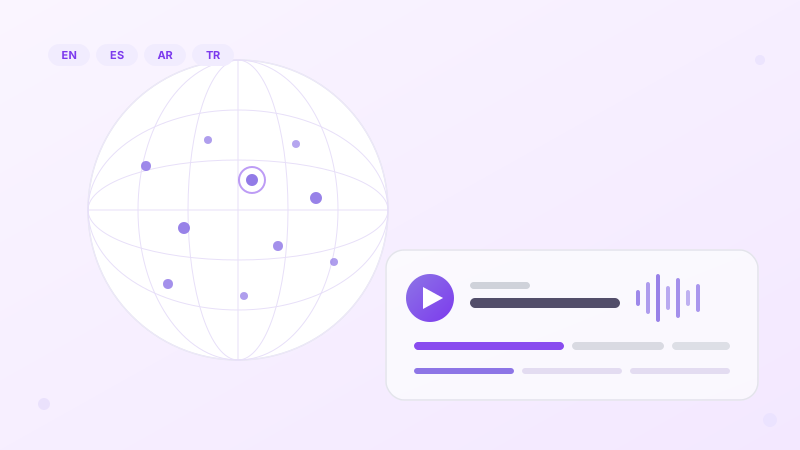
Six agents in order, with a defined handoff between each one and a route back when the work is not ready to move forward.
Swipe the diagram to see all six stages.
Work moves left to right and only moves forward when the stage before it is finished. A story the managing editor will not clear goes back to the correspondent rather than on to narration.
Each agent watches for a specific signal, makes one kind of decision, and hands a finished piece of work to the desk after it.
Most reporting from the countries Lexy covers never appears in English. Searching only in English would quietly narrow the story pool to whatever the international wires already picked up, which is the opposite of the assignment.
Countries in rotation are searched in their own language as well as in English, across twenty one of them, from Amharic and Bengali to Swahili and Urdu.
Anything that arrives in another language is translated as it enters the pipeline, and the original text is kept alongside it.
Because translation happens at the door, a local newspaper and an international wire go through exactly the same selection, matching, and fact-checking afterwards.
Each gate can hold work back, and holding is a normal outcome. It happens between desks, long before anything reaches an audience.
Five tests before a word is written. A real event rather than a situation, at least three confirmed specifics, real stakes, and a point that lands in about ten seconds.
An outlet counts only when its reporting actually matches the story rather than sharing a keyword. Under two independent outlets the brief says so, because the stories worth carrying are usually the ones fewest outlets have.
The full text of the underlying articles is pulled back and every claim is checked against it, in whatever language it was published in.
Hedging, meta-commentary, and punctuation a narrator cannot voice are caught by rules that run identically every time, with a regression suite of thirty-nine cases behind them.
Three stories from three different countries, all still clean when the style rules run a second time. If not, the previous edition stays live.
The brief and its quiz are saved as one piece of work. If the quiz cannot be generated, the stories wait.
The brief, the narration, the captions, and the quiz all come from the same approved text, so adding a platform is a rendering job rather than a second newsroom.
The pipeline is one system. It already produces Lexy Originals every day, and the same desks can be pointed at a different set of sources, a different beat, and a different voice.
Lexy Originals runs three times a day in four languages and is ready now. Embed the player and the companion quiz, take the feed, or put it on your phone line and your smart speaker skill.
The same six desks can run against your sources, your beats, and your editorial standard, producing your brief on your schedule in the languages your audience reads. Deployments are scoped and priced per newsroom.
Notes, experiments, and lessons from building voice-first engagement.
How trusted journalism becomes an interactive voice experience without losing the reporting, context, or judgment behind it.
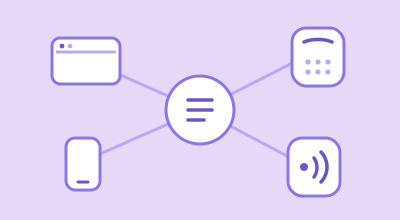
Lexy launched on Alexa without changing the newsroom's routine, because the architecture makes every new platform a rendering problem instead of a rebuild.

Audio has no typography. How a four-note violin phrase, a one-second beat, and a spoken transition became the punctuation system of the Lexy news brief.